Hello! Thanks for “traveling” with me to Japan last week :P. I’m still officially on summer vacation, so although I have lots of things to show you, it’s going to take me awhile to get organized and back to blogging. So here’s another guest post I did for Delia and Kojo‘s FANTASTIC series, Color Your Summer. This is their 2nd year doing this series, I absolutely love it, and I hope they do it every summer from now until forever. I can’t even tell you how thrilled I was when Delia asked me to be a part of this series. Check out all the projects from this summer in this handy round up.
The project is a foldable picnic blanket, and if you get started now, yours can still get tons of use before summer is over and throughout the fall. And if you do make a picnic blanket inspired by this post or using this tutorial, I’d love it if you added it to the you & mie flickr pool!!
_________________________________________________________________________
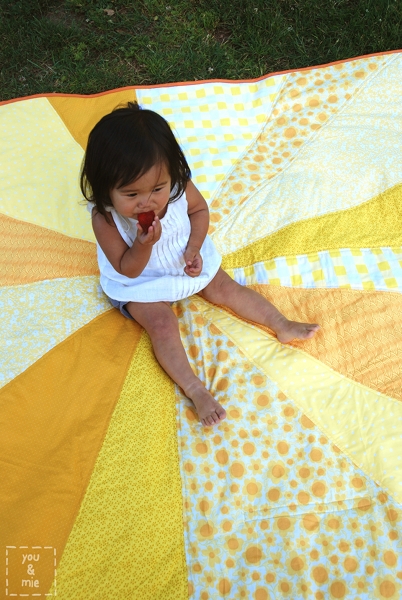
When I think of summer, I think of picnics. When the sun is out, I guarantee that my family will be out at the beach or park with some food and drink to soak up the beautiful weather. It’s one of my absolute favorite activities. So this summer I wanted to create a new picnic blanket to celebrate the start of picnic season.
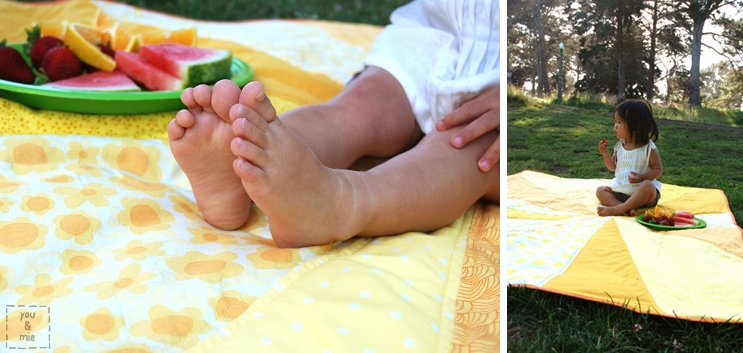
In the past we’ve had a few store bought picnic blankets that we loved for their portability, but they weren’t well made and would start to rip or fall apart after a year. I wanted to create something that was sturdy and easy to carry around, but had the look and feel of a homemade quilt. So I made, what I call, the Sunburst Picnic Blanket.
It is a quilted blanket with a duck cloth bottom. It folds up nicely and is secured with velcro and has a handle for easy carrying.
The design and colors just scream “summer” to me, but of course can be changed to any color(s) or quilt design. Or if you’re not into quilting at all, you can make the picnic blanket with one piece of fabric for the top.
Here’s what you’ll need:
(My finished blanket size is approximately 55 x 59 inches so these estimates are based on that)
– Duck cloth (2 yards)
– Lots of yellow fabric (I had 7 different fabrics, each about a yard)
– Batting (not too thick)
– Bias tape (about 7 yards)
– 1″ wide Velcro (about 12 inches)
– 1″ wide twill tape or other strap material (about 24 inches)
– Coordinating threads
– Denim needle (use any time you are sewing the duck cloth)
First be sure to wash, dry and iron all of your fabrics. One reader mentioned that duck cloth shrinks even with the slightest amount of wetness, so don’t skip this step!!
Cut your duck cloth slightly larger than your desired blanket. Then we need to make a pattern for the quilt top.
As I was deciding the best way to create the design I had in my head, I realized that it strongly resembled Kristin’s Sunshine Dress! I LOVE this dress, so I’m thinking I was subconsciously inspired by it and lucky for me, Kristin made a tutorial for piecing together the color blocked pieces. I basically followed her tutorial for creating the pattern pieces and cutting the fabric. I’ll show you the basics of what I did for the quilt, but you really should check out her tutorial and one of the most gorgeous little dresses ever.
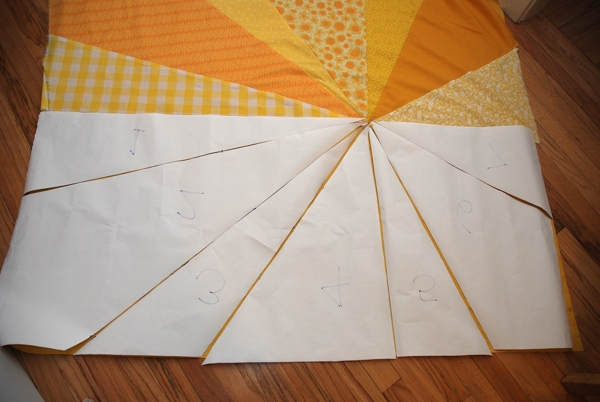
I had a piece of butcher paper the exact width of my blanket, so I used that to make my pattern. I started by making the pattern for the top half of the quilt, but I wanted the epicenter of the rays to be off center, so I made the top ever so slightly longer than the bottom. I picked a spot off to one side where I wanted my rays to shoot out from and I started drawing lines to the outside edge of the paper. I made 7 rays since I had 7 different yellow fabrics. Then I labeled them so I could piece them back together after they were cut (awesome advice from Kristin).
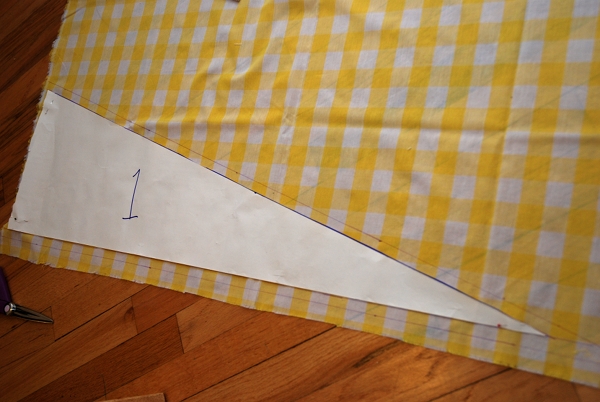
Then I cut the pattern pieces out and traced them onto my fabric. Remember that if you want your finished quilt to look exactly like the pattern you drew, you’ll need to put the pattern right side up on the right side of your fabric OR flip your pattern over and trace onto the wrong side of the fabric. When you trace your pattern onto your fabric add 1/2 an inch for seam allowance along each of the long edges.
I found it easiest to only cut out the pieces as I was ready to sew them. So I cut out pieces 1 and 2, and sewed those together. Then I cut piece 3 and sewed that to piece 2 and so on. That way I didn’t mix up the pieces or get confused about which piece or which side to sew next.
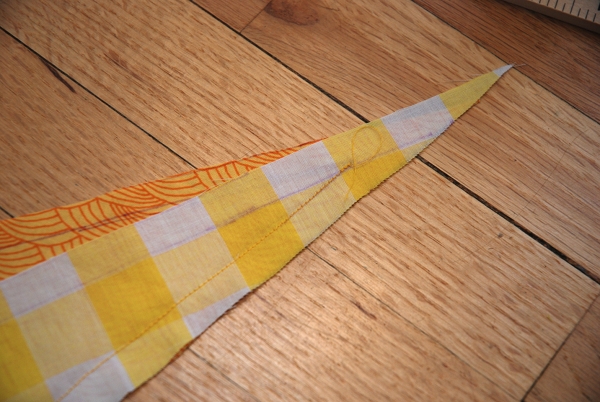
When you sew the pieces together use a 1/2 inch seam allowance and always start from the point. Try to line up all the points as carefully as possible so it looks sharp.
After you sew each piece on, press and trim extra seam allowance off. There is going to be a lot of fabric gathering at the center point, so you’ll want to remove what you can.
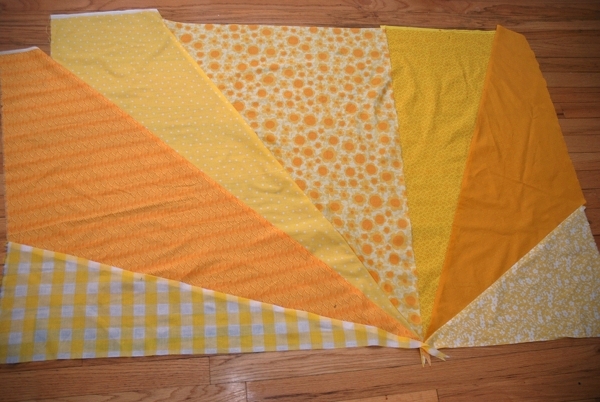
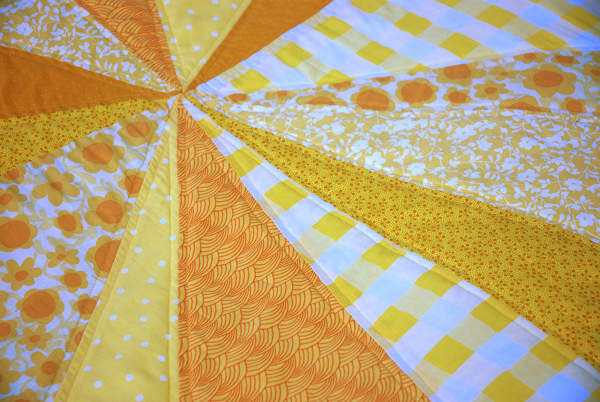
When you sew all the pieces of the top half, it should look something like this.
Trim the extra fabric at the point, if you haven’t already.
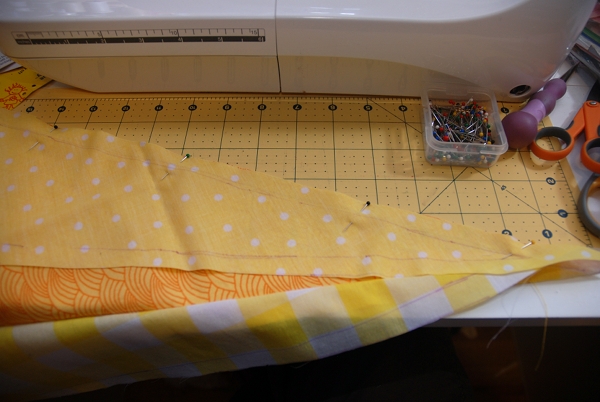
For the bottom half, I simply flipped the pattern over. By laying the top part of your quilt and the pattern pieces on top of your cut duck cloth, you can see the finished length of the quilt and trim the pattern pieces since the top part of the quilt is longer than the bottom.
Repeat the same steps to create the bottom portion of your quilt top. When you’re done, lay the bottom part on the top part, right sides together, and making sure the all points come together exactly in one spot. Since your top and bottom are mirror images of each other, the rays should line up. Pin the pieces together and sew them together using a 1/2 inch seam allowance.
Press the seam open. There will be a lot of fabric coming together at the center point so it’ll be tough to press open, but just do your best and it’ll look fine. Your quilt top is done!!
Layer your duck cloth, batting and quilt top and trim the sides so they are straight.
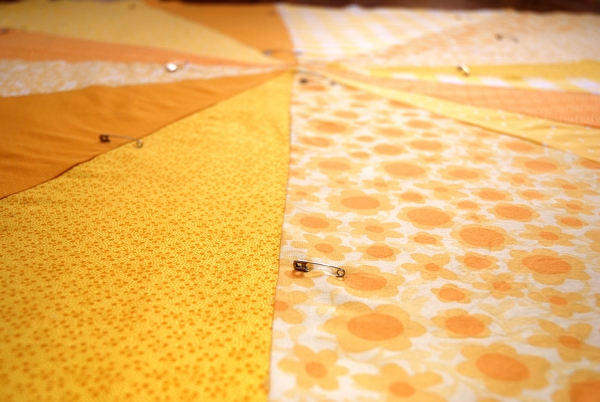
Baste the 3 layers together so they don’t shift while quilting. I use the safety pin method.
Quilt the three layers however you’d like. I quilted each “ray” about 1 cm on the inside of the seam creating large V shapes, using a walking foot.
Since none of the V’s reached the center of the quilt and that was where it was the thickest, I decided to freehand quilt a little star in the center. You can’t see it from the top, but SURPRISE . . .
There it is on the bottom!
Now on to the closure flap (the piece of fabric with the handle and the velcro – I don’t know what else to call it). First measure the width of your quilt. Then divide that by 5. My quilt is 55″ wide, so my closure flap is 11 inches wide. You’ll need to cut a piece of duck cloth and coordinating fabric that is the width that you just calculated by about 11 inches. So I had a square.
Use something circular to round 2 of the corners. The edge with the rounded corners is going to be referred to as the bottom of the flap.
Baste or pin the two layers together so they don’t shift while completing the next few steps.
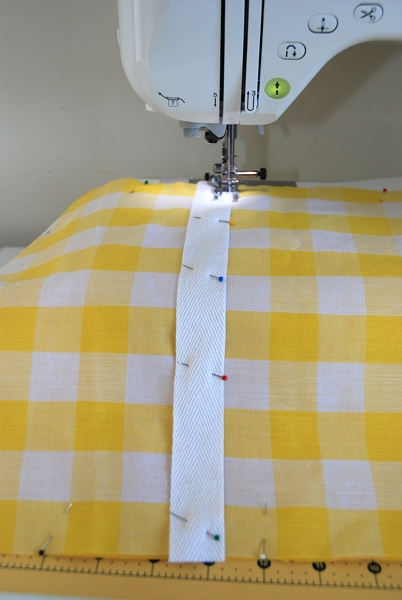
Take your twill tape and sew it onto the fabric side (not duck cloth side) along the width about 4 inches down from the top of the flap (the edge without the rounded edges).
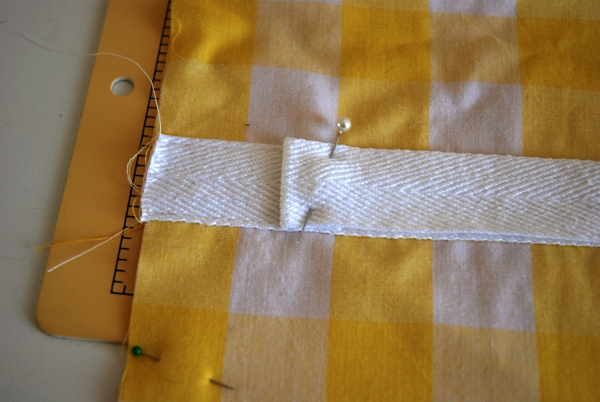
Take another piece of twill tape and fold it under 1/2 an inch. About 1.5 inches from the edge, pin the twill tape down.
To make sure the handle is firmly secured, sew in a square and add an X between the corners. Go over each line several times.
Do the same thing on the other side except add an extra 1/2 inch of strap before you cut, so the handle stands up a bit.
On the duck cloth side of the flap, attach the soft side of the velcro 1/2 an inch above the edge with the rounded corners. Trim the velcro to match the rounded corners.
Finish the edges with bias tape.
Line up the center of the flap with the center of the top edge of the quilt. Pin them together with the handle side of the flap facing the duck cloth side of the quilt.
At this point I decided to round the 4 corners of my quilt as well (no dealing with mitered corners!!). Finish the quilt with bias tape.
We’re almost done! All we have to do is add the other side of the velcro to be able to close up the quilt.
First we have to fold up the quilt and here’s how:
1. Lay the quilt out flat, with the flap out at the top.
2. Fold the two sides in till the edges line up with the edges of the flap.
3. Fold the sides in again so they line up with the flap.
4. Fold it in half.
5. Fold it in half again.
6. Fold it in half one more time and pull the flap down.
Mark the placement of the velcro.
Then unfold the quilt and sew the scratchy side of the velcro according to your markings and you’re done!!
Grab some family and friends, some food, drinks, games or books and head out into the sun!
And in case you want to see how to fold up your new picnic blanket again, I made my first gif ever!
Hope you get some good picnicking in this summer and fall! Please let me know if you have any questions or need me to clarify anything. I love to hear from you!
By they way, what’s your favorite summer activity?

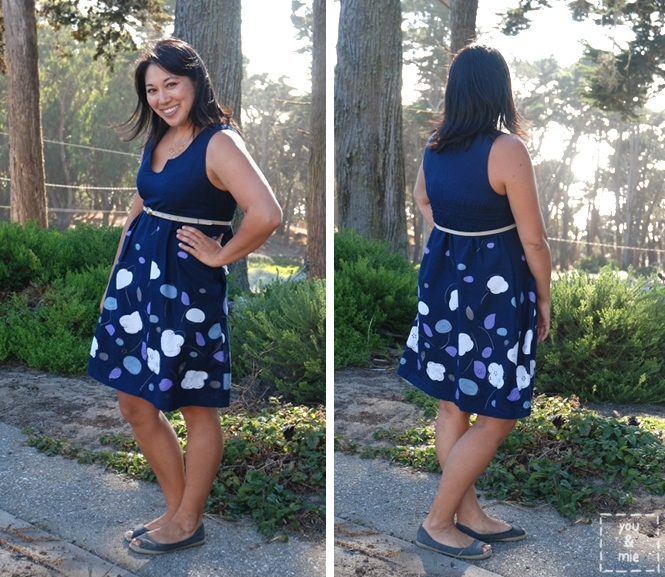
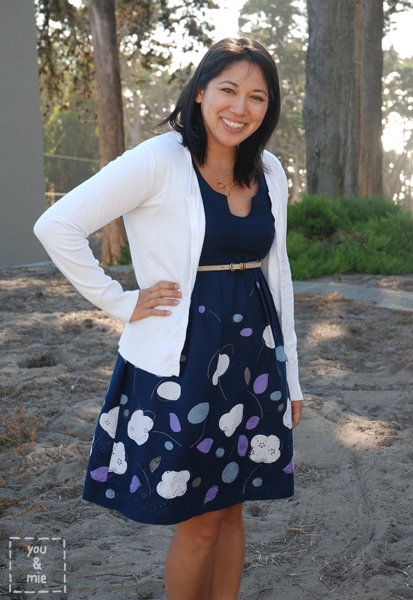
 But I did want to tell you about a series that is going on right now on the Sew Together blog. Caroline and Maryanne have invited some bloggers to share about their best sewing friend – “a pattern, a tool, a technique, a blog, a hint or a person who inspires you to sew.”
 While you’re over there, you should also check out the guests they’ve already had and continue checking back over the next couple of weeks for some fantastic bloggers sharing about their best friends every few days.















 you and mie