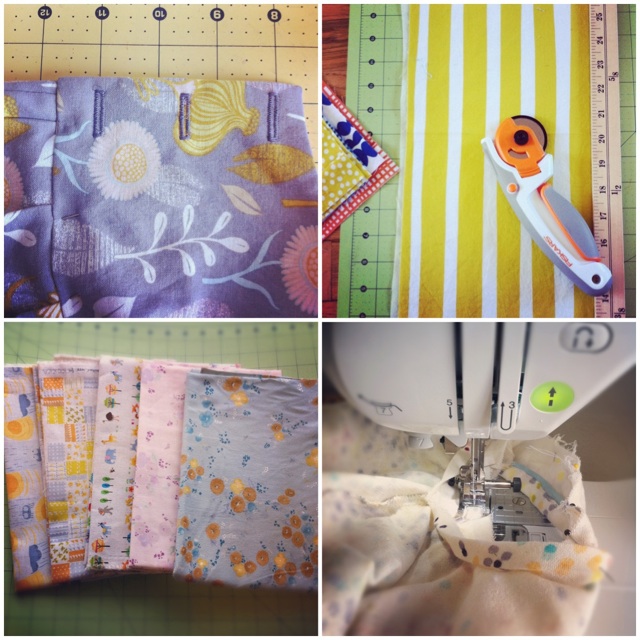
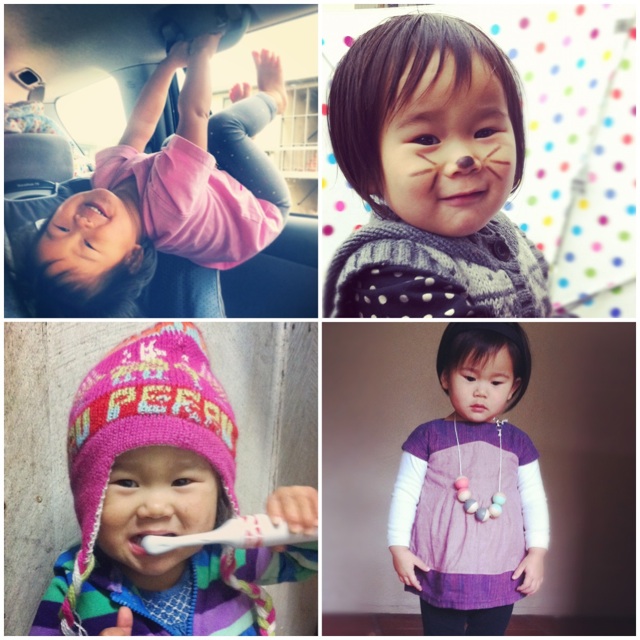
Finally sewing again!

So I took a break from sewing . . . a 22 day break (who’s counting ;))

But now I’m back!

ReversibleCoatAnd my first project is this reversible spring coat that I made for iCandy Handmade’s Basic Bodice Series.  You can catch the full tutorial over there!

The idea behind the Basic Bodice Series is that if you have a great bodice pattern and know how to alter the pattern or add some embellishments, the possibilities are endless in terms of what you can create.  So this coat, and all the other projects from series guests, started with a basic bodice pattern.  You probably already have one in your pattern collection.  In my tutorial I’ll show you how to alter your pattern to make a reversible coat!

They also have a linky party going on right now for all of you who want to share YOUR basic bodice creations.  So if you’ve ever used a bodice pattern to make something, link it up here and your outfit might be featured at the end of the series!

ReversibleCoat1I still can’t believe I cut into my Nani Iro Metallic Pocho for this coat.  This stuff is GORGEOUS (and not cheap)!  But it feels good to just go for it sometimes, and I think it paid off this time.  Yuki looks pretty darn cute in her fancy coat 🙂  And I wish you could see the subtle shimmer of these dots!  Man, it’s beautiful.  I really think the next time I sew with Nani Iro, I need to make something for me!

Anyways, it feels good to be back at the machine.  I’ve got lots of fun things coming up, so it’s time for me to get busy!

But for today, please hop on over to iCandy handmade to check out my tutorial and say hi!

Thanks 🙂

Confused Geese Pillow Cover {tutorial}

Like I said, I didn’t make too many Christmas gifts this year.  But I did make one more.  This is the last one.  I’m pretty sure.

Our best friends, Sanjai and Jude, are truly amazing.  They invite us over to their house every week, cook amazing meals, are the BEST with Yuki and overall, just take great care of us.  Over the last several years we’ve become very close and their house has become our second home.  And it. is. gorgeous.  If you follow me on Instagram (@youandmie), you’ve probably seen pictures of their house.  And one day maybe I can give you a full tour because it really is magazine worthy.

Anyways, we love spending time there and so does Yuki.  They take great pride in their home and they have amazing style.  When I was thinking of a gift for them, a throw pillow seemed most appropriate because I knew they could put it wherever they wanted and switch it out with other covers depending on how they were feeling/decorating at the moment.

Around that time, Jessica from A Little Gray posted a work-in-progress picture of this pillow cover she was working on and she happened to mention “flying geese” in the caption.  Lucky for me, because I didn’t know these cool triangle patterns had a name!  (but of course they do).  Once I looked up what “flying geese” were, I was hooked.  I’ve totally fallen for the triangle craze and I was drawn to this particular pillow cover.  I was just going to copy it exactly, with a row of triangles, but as usual, I had to go and make it all complicated 😛

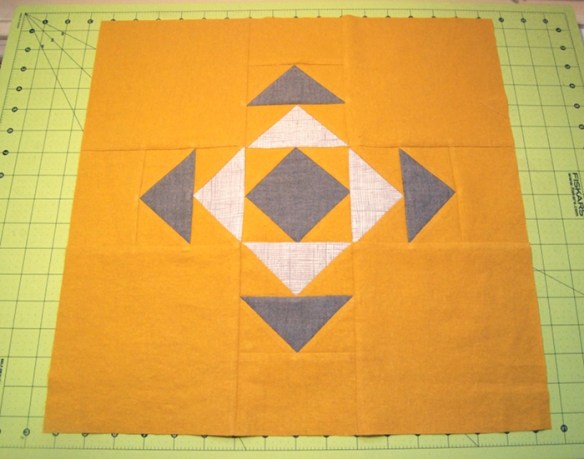
So I played around in my sketchbook a bit and came up with this design.
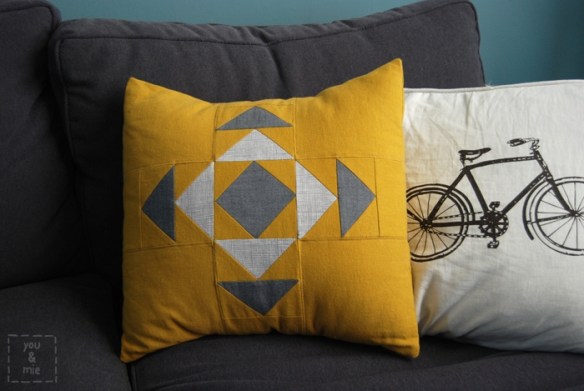
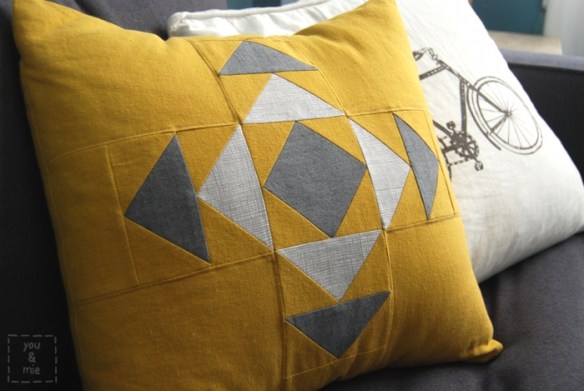
Confused GeeseConfused Geese1I call it the Confused Geese Pillow Cover.

Why confused?  Because all of my geese are flying in different directions . . . get it!??

Haha.  Anyways, it’s a simple envelope pillow and I like the way it came out except it’s a bit too snug on the pillow form.  I had read somewhere that for an 18×18″ pillow form, a 16×16″ cover would fit well.  But it’s a bit too snug, on two sides anyways.  Maybe I’d give it an extra inch for room if I were to make it again.

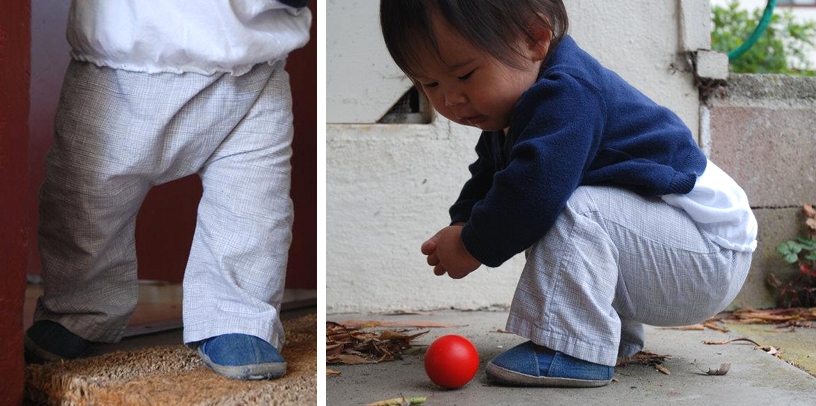
I used a mustard linen blend that I had originally bought for another project – but it ended up being perfect for this.  Great color, soft enough for comfort but sturdy enough for a throw pillow.  The geese and center diamond are made from fabric scraps in my stash.  The dark gray is the chambray I used for my Darling Ranges Dress, and the light gray is a quilting cotton that I used to make my first pair of pants ever for Yuki when she was about one.  I never blogged it, so here’s a picture.

Simple Baby PantsAwww, baby Yuki learning to walk . . .

Anyways, there are tons of great tutorials out there to teach you how to make flying geese (which is how I learned), but in case you wanted to put together this exact pattern, I thought I’d show you how.  There are a lot of numbers, but I have all the measurements for you, so even if you’re not a quilter or you’ve never made flying geese before, it’s really quite simple.  I will say, however, it takes a bit of patience and attention to detail if you want all your corners to come out sharp.  Mine certainly aren’t perfect (so don’t look too close)!!

As I mentioned, my finished pillow cover was 16×16 inches.  I’ll give you all the measurements for that (and in parenthesis I’ll note the size I’d use to make a 17×17 inch cover).  If there is no parenthesis, you should use the measurement listed for both size pillow covers.

For your main fabric, you’ll need:
– 4 squares that measure 7 x 7 inches (7.5 x 7.5)
– 4 rectangles that measure 4.5 x 3 inches (4.5 x 3.5)
– 12 squares that measure 2  7/8 x 2  7/8 inches
– 2 rectangles that measure 12 x 17 inches for the back of the pillow (12.5 x 18)

For Accent Fabric A (which in my case is the dark gray chambray), you’ll need:
– 2 squares that measure 5.25 x 5.25 inches

For Accent Fabric B (the light gray), you’ll need:
– 1 square that measures 5.25 x 5.25 inches

You’ll also need:
– a 17 x 17 inch (or 18 x 18) piece of fabric to use as backing for the pieced pillow cover.  I used my main fabric, but you can really use whatever you like as it will only be on the inside of your pillow cover and won’t really show.

*seam allowance for piecing the entire pillow top is 1/4″
*seam allowance for sewing the pillow front to back pieces is 1/2″

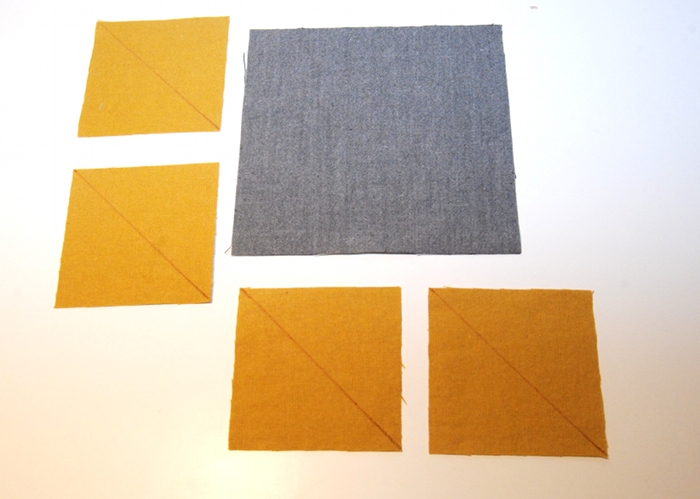
Ok, to start, you’ll need to make your flying geese!  Grab one Fabric A square and 4 of your 2  7/8 squares.  The large square will become the “geese” (large triangles) and the small yellow squares are called “sky” pieces.
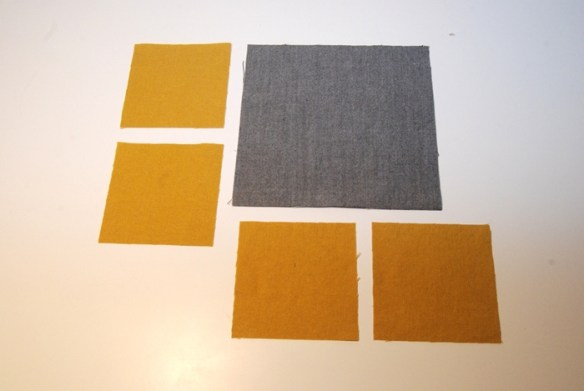
FlyingGeese01Now go and follow this tutorial on how to make 4 flying geese.  I like this tutorial, not only because it’s easy to understand but because she is making the exact same size geese as we need!

Take your time and make sure to sew straight and press well.  This will help get neat looking triangles.  Now repeat with Fabric B to make 4 more flying geese.  You should have 4 geese with Fabric A and 4 with Fabric B.

To make the diamond in the center of the pillow, you’re going to need your last Fabric A square and the last four 2  7/8 squares of your main fabric.  It’s going to start out a lot like you’re making flying geese.

FlyingGeese02Draw diagonal lines from one corner to the opposite corner on all 4 of the small “sky” squares.
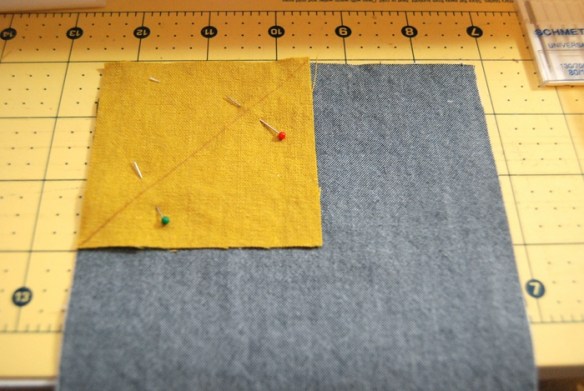
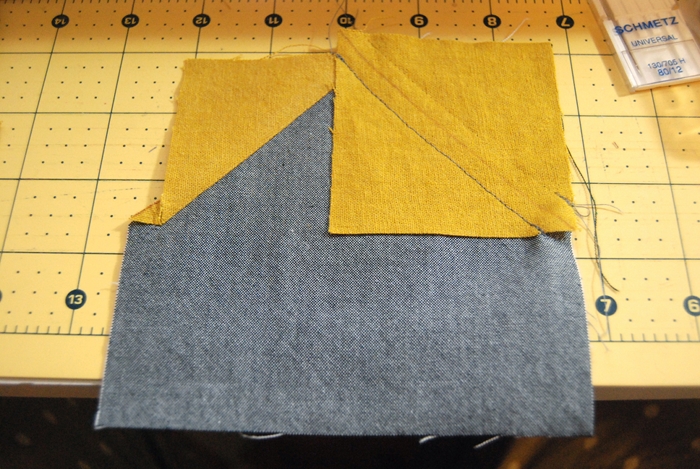
FlyingGeese03Place one “sky” piece in the corner of the large square with the diagonal line cutting across the corner (not lined up with the corner).

FlyingGeese04Sew 1/4″ along the inside of the line (towards the center of the large square).  Cut away the excess fabric directly on the line and press open.
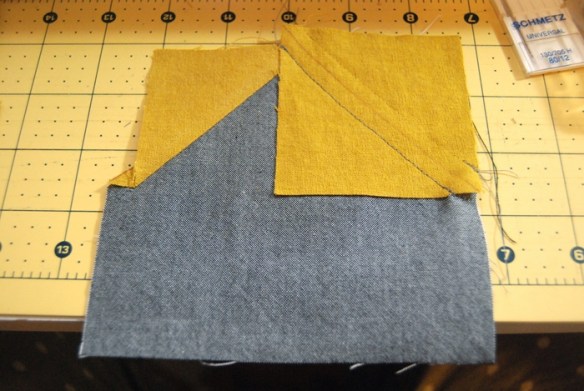
FlyingGeese05Going clockwise, place another “sky” piece in the next corner and repeat (you can see that I accidentally sewed on the outside of the line and then went ahead and unpicked it, even though it was going to get cut off in the end!  Doh!)
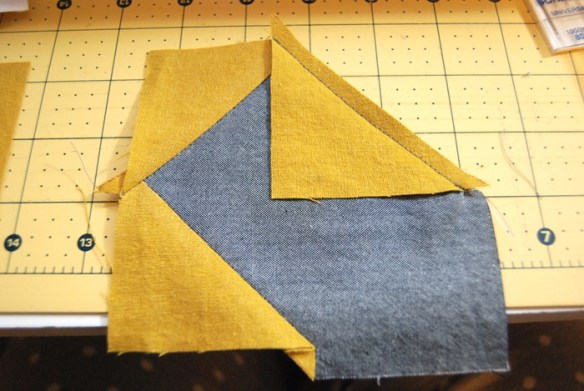
FlyingGeese06Repeat with the next corner.  Trim and press.

FlyingGeese07Done!  Now you’re ready to piece all your geese together!

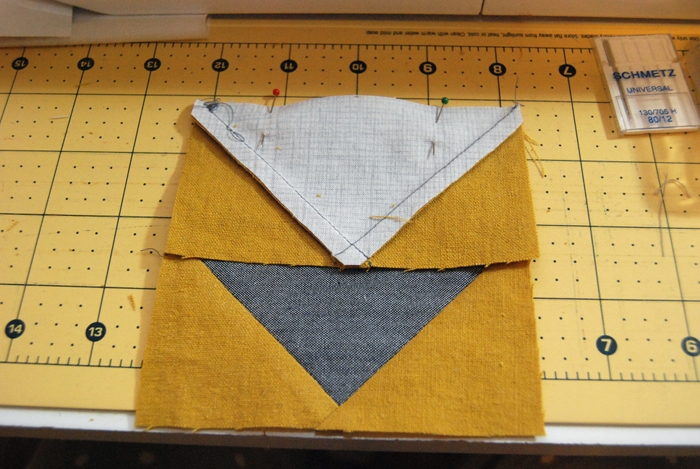
FlyingGeese08Line up one edge of your diamond piece with the base of a Fabric B triangle, right sides together.  Sew with a 1/4″ seam allowance.  Press open.

I didn’t take pictures of every step here because it gets a bit repetitive.  It should be fairly straightforward though.

Attach a Fabric A “goose” to the Fabric B “goose” in the same way.  Repeat to the opposite side of the diamond.  Your center panel is now pieced and should look like this:

FlyingGeeseLayout(Excuse my rough sketch – it is not to scale)

Sew one of the 4.5 x 3 inch (4.5 x 3.5) rectangles (in the main fabric) to the top of the panel and one to the bottom, using a 1/4 inch seam allowance.

Set that aside.  Sew together the top of a Fabric B triangle to the base of a Fabric A triangle.  Then attach the top of the Fabric A triangle to your 4.5 x 3 (4.5 x 3.5) inch rectangular piece of the main fabric.  Press each seam open and repeat with your last two geese.  These are what your 3 pieces should look like:

FlyingGeese10Following along so far?  Ok, good!

FlyingGeese10_1Grab your 7 x 7 (or 7.5 x 7.5) inch squares and sew them onto the sides of the 2 small rows of the triangles to complete the side panels.

FlyingGeese12Line up the edges (right sides together) and sew with a 1/4 seam allowance.  Repeat with the other 3 corner pieces and your side panels should look like this:
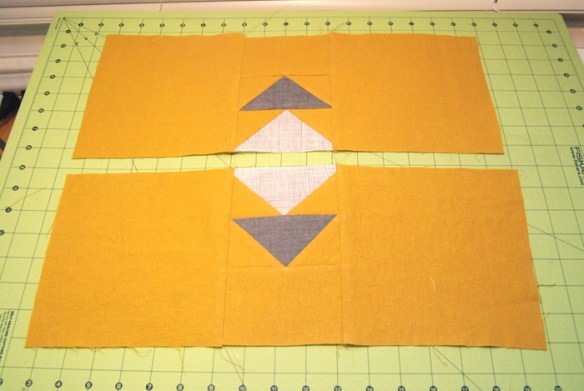
FlyingGeese13

FlyingGeese14Now sew the side panels to the center panel with a 1/4 inch seam allowance and your pillow cover top is complete!!
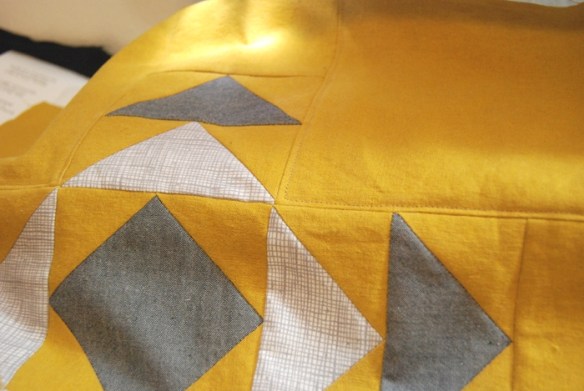
FlyingGeese15Place it on top of your 17 x 17 (18 x 18) inch backing and quilt the layers together however you like.  I kept it simple.

Now to complete your pillow cover, take one of your 12 x 17 (12.5 x 18) inch rectangles and hem one of the longer sides by folding under by 1/4″, pressing, folding under another 1/4″, pressing and then sewing along the fold.  Repeat with the other back piece.

Now to sew the front and back pieces together, place your pillow top right side up on a flat surface.  Place one of the back pieces on top, right sides together, lining up 2 of the the corners and with the hemmed edge towards the center.  Place the other back piece, right side down, also with the hemmed edge towards the center of the pillow, lining up the corners.  The back pieces should overlap by about 6 inches.

Pin along the outer edges of the pillow and sew around all 4 sides with a 1/2″ seam allowance.  Trim and/or finish edges as desired, turn right side out and press.

You’re done!  If the construction of the front and back pieces is confusing without pictures, search for “envelope pillow tutorial” and I bet you’ll find a million.

Now stuff the pillow cover with your pillow form, step back and admire your work!

photo(24)If you make a Confused Geese Pillow Cover, don’t forget to upload your photos to the you & mie flickr group!

Hope you all have a wooooonderful weekend!  3 days off for me – yipee!

Baby Geranium

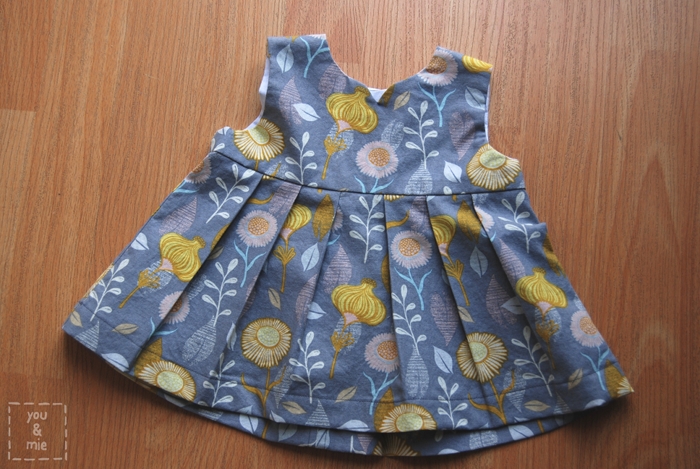
I only made a few gifts this holiday season, but when I found out I was going to be visiting my favorite lil baby, Logan, I knew I had to make her something.  Logan is 7 months old and the daughter of one of my best friends from high school.  She lives in LA and she is precious!  And since I had Geranium on the brain, I just had to sew up another one!

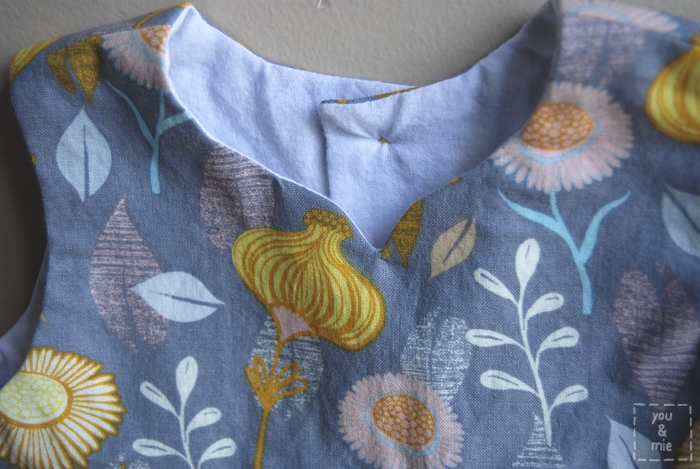
Logans Geranium1The pattern is Made by Rae’s Geranium Dress pattern and if you’ve checked out the pattern, you’ll know there are a ton of options you can choose for the dress.  I was tempted to stick with my favorite combo (see my eyelet version), but decided I should try something at least a little different!  With the advice of Melissa and Kristin, I settled on something simpler for lil 7 month Logan.  Tunic length (more practical for the soon-to-be crawler), no sleeves, pleats (Logan is a modern and sophisticated gal) and of course, the notch.  I can’t forgo the notch!

Logans Geranium2Most patterns I own, I’ve only sewn once.  This pattern is one I know I’ll sew from over and over again.  I already have ideas for lots of cute different Geraniums, but alas, Yuki only has one body.  Good thing this pattern goes up to size 5T!  Plus it’s a really simple yet beautiful project, so it makes the perfect gift!

Logans Geranium3Here’s a close up of the notched neckline.  Definitely my best yet (out of two), but still not perfect.  It’s got a tiny dimple near the bottom that I couldn’t press flat.  I’ll get it right one of these times!

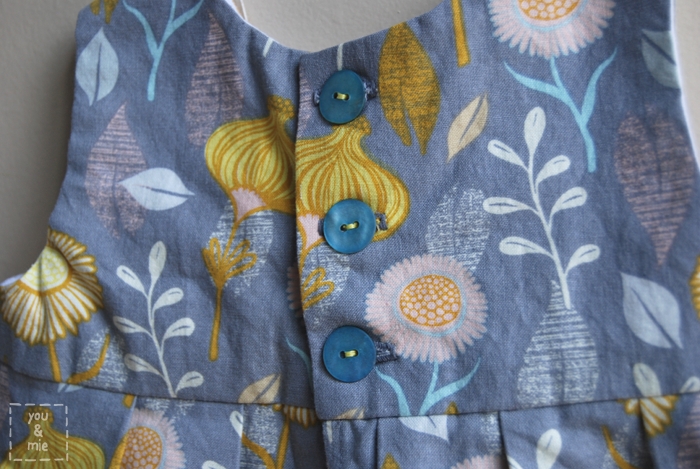
The fabric is from the line Timber & Leaf by Sarah Watts (you should check out the rest of the line – it’s gorgeous!).  I bought it at one of my new favorite fabric stores in the Bay Area, Stonemountain and Daughter in Berkeley.  I’ve gotten a lot of amazing things there recently and if it weren’t across the bay, I swear, I’d be there all the time!

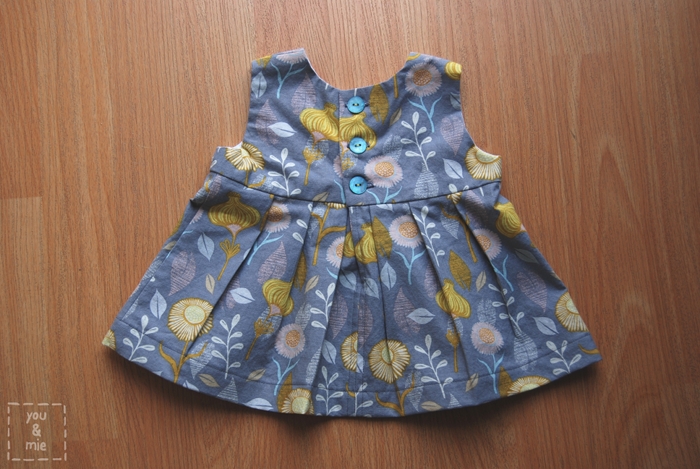
Logans Geranium4The back closes with 3 beautiful blue buttons just like Logan’s eyes.  I was going to sew them on with gray thread, but the needle I happened to grab already had some almost-neon yellow thread in it that I ended up using.  Thought it went well.

I made the dress in size 6-12 months and I think it’ll still be a little while before she can wear it.  But by then the weather will have warmed up and it’ll be perfect for a crawling and cruising and maybe even walking lil Logan!  Oh, they grow up so fast!!  *sniff sniff*

I’m slowly getting back into the swing of things around here, but I’ve been a bit under the weather so it’s been tough.  To be honest, I haven’t touched my sewing machine since I left for my winter vacation 2 and 1/2 weeks ago even though I’ve already been home for over a week!  I’m hoping to get my sewing mojo back again soon.  But don’t worry, I’ve got lots of new projects planned for around here, including my post for the Basic Bodice Design series over on iCandy handmade coming up next week!

How are you doing?  Did you take a little break after the busy holiday season?  Or did you dive right back in?

Do you Instagram?

Oh yeah.  It’s a verb now.

photo(23)follow me @youandmie

If you like to keep up with the latest social media crazes you’ll know Instagram is pretty huge right now.  It’s basically a photo sharing app for your phone or other mobile device that people use to capture and share beautiful, funny, strange or otherwise noteworthy moments of their day.  I’ve been on Instagram officially for 2 years now, but only started posting regularly one year ago and only REALLY started using it as a way to share and connect with other people in the sewing/crafting/blogging community within the last 6 months.

I’m addicted.

But until now, I’ve kept my photos private which means that you could only see them if you requested access and I accepted.  But as I’ve started connecting more with more bloggers, I’ve discovered how fun it is to get peeks into their daily lives.  I really feel like I’ve made friends with people through Instagram because we share our daily triumphs and trials, our meals and our messes, our projects, our families and even the mundane.  It’s really really fun.

So I’m opening up my account to the public in case you’d like a peek into my life.  My username is youandmie.  And if you’re on IG, feel free to leave your username in a comment, so I can check it out!

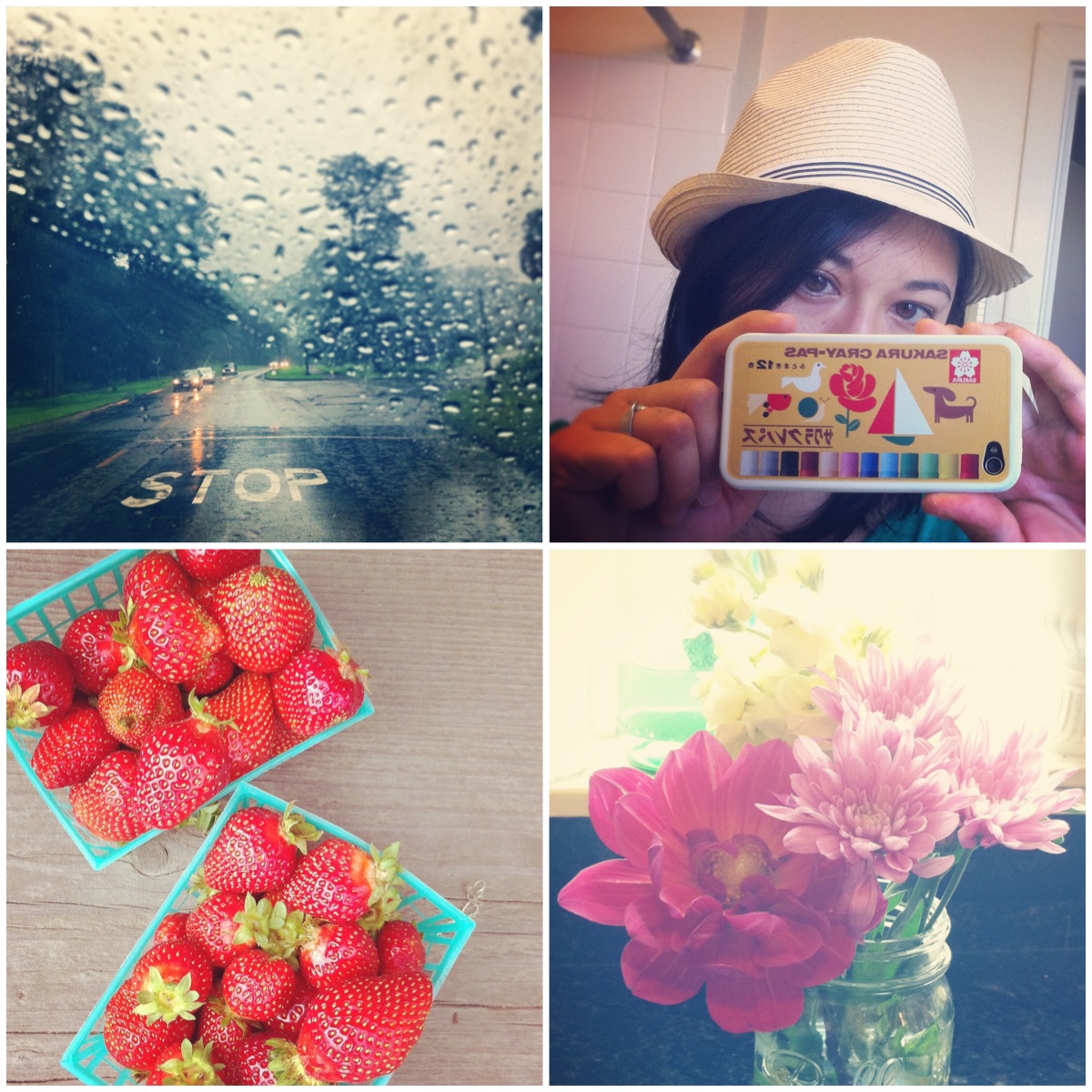
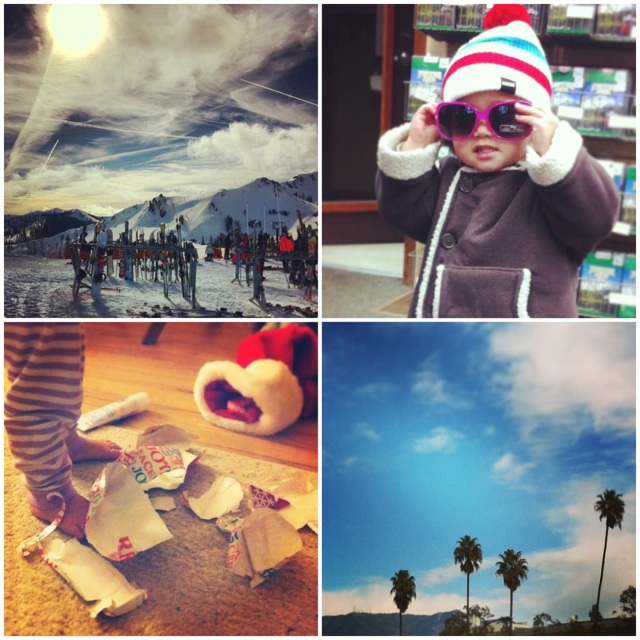
If you’re already a follower, you’ve recently seen pictures from my winter break . . .

1000004761And I also like to post pictures of . . .

1000004764fabric and sewing projects (both complete and in progress,) and sometimes I even ask for advice while working on a project if I can’t make up my mind!

1000004765 the beeeeeaautiful place I call home

1000004763the food I eat (looks like I might need to start eating healthier)!

1000004762a looooooooooot of pictures of this kid

1000004767and little moments from my day that make me smile.  Like when my daughter tried to run away from home.  Naked.

If you’re not on Instagram yet, I dare you to check it out and NOT get addicted 🙂  Pretty much all of my favorite bloggers are on there sharing gorgeous and hilarious photos of their lives and it’s such a fun way to get to know people.  Checking my IG feed is one of my favorite things to do because I know someone’s photo is bound to have me laughing out loud.

Anyways, you can find me @youandmie if you’re interested!

Do you Instagram??

Quilted Jacket {Mini Boden Knock Off}

Since I’m on a little vacation, I thought it might be a good time to bring home some guest posts that were originally posted on other blogs.  This is one of my favorites from this past year (did you see my top 12?) that was posted on Elegance and Elephants for her Knock It Off series.  Enjoy!

_______________________________________________________________

I love sewing all sorts of things, but sewing for my daughter is my absolute favorite.  I’m also a huge fan of Heidi’s and I think this series is absolutely brilliant – I mean, who doesn’t love a good knock off?!

But I didn’t realize just how hard it was going to be to pin down just ONE thing to knock off!  There are soooo many awesome store bought outfits out there just waiting to be made at home.  I checked out some of my favorite knock-off inspiration pinboards (here, here, and here) and consulted with my favorite idea girl, Kristin, and with her help FINALLY decided on this Mini Boden Quilted Jacket.

QuiltedJacket26

I love that the jacket is super stylish, warm and comfy and the bias tape finishing actually makes the construction really quite simple.  I also love unisex patterns AND, get this, it can be reversible!!  The most time consuming part is the quilting, but it goes quickly once you get going (or you can buy pre-quilted fabric).  So let’s get started!

You’ll need:
– Main fabric
– Lining fabric
– Batting
– Double fold bias tape
– 4 buttons (or 8 if you’re making a reversible jacket)
– Chalk or fabric marking pen
– Coordinating thread
– Walking foot (optional)

Draft your pattern:
To draft your pattern, start with jacket or top that fits well and draft the back piece on the fold.  The jacket has a slight A-line shape, so draw a slight slant from the bottom of the armhole to the bottom corner of the pattern.

I need to mention that my jacket turned out quite snug on my daughter and I’m wondering if the batting had something to do with that.  I’d suggest giving your pattern some extra wiggle room when you draft it.

To draft the front piece, trace the shoulder, armhole and side and bottom of the back pattern.  The neckline should scoop lower and the center should extend past the back piece (mine extended 1.5 inches) and round your edges.

Using your well-fitting jacket, draft a pattern for the sleeves, a 3 piece hood and a pocket.

Cut your fabric:
Here’s what you’ll need to cut . . .

*If you want to make the jacket reversible, cut 4 pockets of the lining fabric as well.*

When I cut my batting, I pinned the main fabric to it and just roughly cut around it in case the batting shifted.

Quilting:
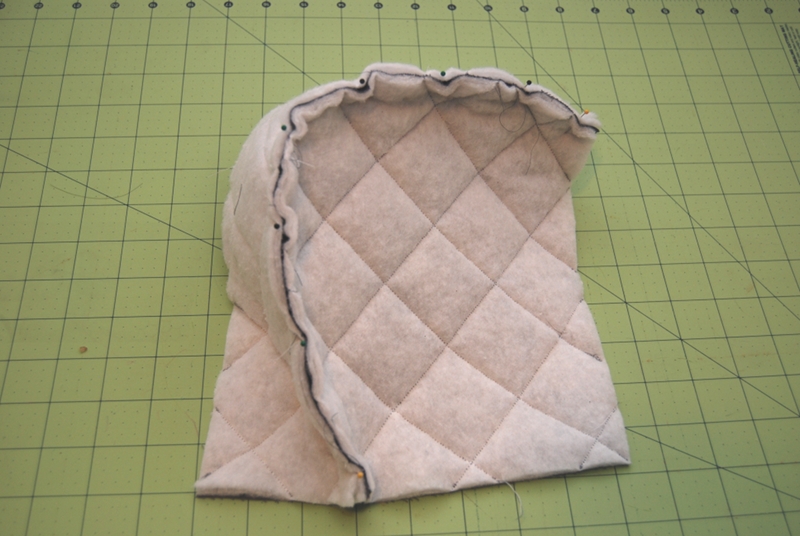
Now, we quilt!  We’re only going to quilt the main fabric to the batting.  Because I’m sorta anal, I wanted to center my diamonds.  So first mark a line down the center of the pattern piece.  Then make another line at 45 degrees.  I decided to make my lines 1.75 inches apart, so I cut a piece of cardboard of that width to help mark the rest of the lines.  Once you have your lines marked, sew along each line, using a walking foot if you have one.

To center your diamonds, draw a 45 degree angle going the other direction making sure to cross a point where the center line intersects with one of the lines you already quilted (red dot).  Use your cardboard ruler to mark the rest of your lines and quilt.  Trim the excess batting.

Repeat these steps to quilt all of your main/batting pieces.

Construct hood:
With right sides together, pin the curved side of the hood to the center panel and sew.  Repeat with the other side.  Press seams open.

Top stitch along the inside of your hood seams.

Attach pockets:
Position your pockets (right sides together) on the front and back pieces of the jacket, making sure they line up.  Sew along the straight edge.  Press open.

Attach shoulder seams:
Pin the front and back pieces right sides together at the shoulder and sew.  Press seams open.

Attach hood:
Line up the center of the jacket back with the center of the hood and pin, right sides together.  Pin the hood along neckline.  You want at least 2-3 inches of the jacket front to extend past the edge of the hood (I had to trim my hood back a little bit for it to fit).  Sew the hood on and press seam open.

You’ll have the extra seam allowance along the top edge that extends past the hood.  Trim that down and round the edge (I think this will make more sense as you’re sewing).

Attach sleeves:
Pin the center of the sleeve to the shoulder seam and then carefully pin the rest of the sleeve along the armhole, curving the fabric as you go.  When sewing, start from the shoulder seam and work your way down to the bottom of the armhole slowly.  Then start back at the shoulder seam to sew the other side of the sleeve.  Repeat with second sleeve and press.

Top stitch along the inside of the sleeve seam.

Side seams:
Turn your jacket inside out and pin the sleeves, sides and pockets together and sew.  Clip corners.  Flip your jacket right side out (your pocket will automatically be turned in) and press seams well.

Construct lining:
Follow the same steps to construct your lining, omitting the top stitching (if you are making a reversible jacket, add the pockets as you did previously.  If not, skip those steps).  This should come together really quickly and easily this time around!

Attach lining:
Once your lining is complete, slip it into the outer layer of the jacket, wrong sides together.  Make sure to carefully line up the seams and edges.  Pockets should be pointed towards the front of the jacket and be hidden between the lining and jacket.  Baste along the outside of the jacket very close to the edge to attach the layers together.

Binding edges:
We’re almost done!  To finish the edges, unfold your bias tape and starting from the bottom of the jacket, a few inches from a side seam, pin your bias tape along the edge of the jacket.  Make sure to leave several inches of bias tape free before you start pinning.  Continue along the entire edge of the jacket, being careful around curves.  You should have one continuous long edge starting at the side seam, up the front of the jacket, around the hood, back down the other side and along the bottom.  When you get close to where you started, measure where the ends will meet and sew the two ends of the bias tape together.

Sew along the crease of the bias tape closest to the edge.  Flip the bias tape over the edge of the jacket and fold the other edge of the bias tape back under.  Make sure to cover the stitch line with the edge of the bias tape and pin.  From the outside of the jacket, top stitch along the bias tape just next to the seam.

For the sleeve, measure the length around the sleeve and cut two pieces of bias tape one inch longer.  Unfold your bias tape and sew the ends right sides together with a 1/2 inch seam allowance creating a tube.  Press seam open.  Pin the bias tape along the edge of the sleeve and repeat same steps as before to attach binding.

Buttons and buttonholes:
Sew on your buttons and make buttonholes where desired.  If you are making a reversible jacket, sew buttons to both sides of the jacket.

And you’re done!

QuiltedJacket24
QuiltedJacket25
QuiltedJacket27

I hope you can make your little one something warm and comfy this season.  Please feel free to visit me at you & mie some time and if you make a quilted jacket, please add it to the you & mie flickr group because I love to see your creations!